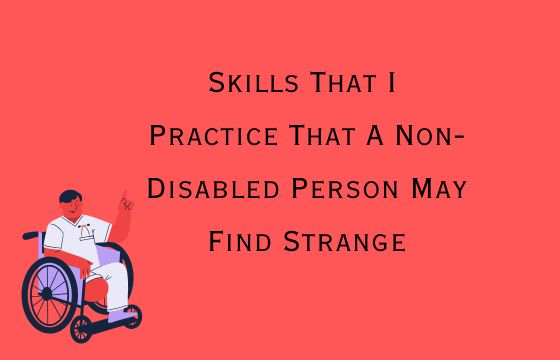
When you are disabled, you have different skills than non-disabled people because you have to do things in a slightly different way to accommodate your disability. Disabled people sometimes are better at certain things than non-disabled people because we have to develop skills that a non-disabled person wouldn’t need to be able to navigate in a world that is not designed for us. Skills that a disabled person needs to function often take years to master, and the last thing you want to happen is to forget how to do something that you need to stay safe. As a physically disabled person, I have learned different ways to do every task because I can’t do things in the same as a non-disabled person. Sometimes you may see me practicing certain things that a non-disabled person wouldn’t even think about, and you may wonder why I am doing that. What skills do I practice doing that a non-disabled person might find a little odd? In this post, I am going to talk about skills you may see me practicing that a non-disabled person may find a little strange.
I practice falling- When I was a child, I went to physical and occupational therapy to learn how to walk because I can’t walk without assistive devices and had to learn how to use crutches. While I was learning how to walk, I was taught how to fall because people with physical disabilities fall more often than non-disabled people. As a physically disabled person, I am more prone to falling, but I don’t fall every day, and when you don’t do something every day often those skills get a little rusty. I practice falling regularly so when I do fall, I remember the safest ways to do it to minimize injuries. When I practice falling, it’s always in a controlled environment, and I am never doing anything unsafe that would cause an injury. I have practiced many different positions from which I could fall, so when it actually happens, I know what to do. I still sometimes fall and injure myself because practicing doesn’t guarantee you’ll never get hurt, and it only helps you be a little more prepared. I don’t seriously injure myself when I fall very often because I know how to do it properly. Learning how to fall has been one of the most useful skills I have learned that have prevented so many trips to the ER.
I practice doing things with one hand-As a physically disabled person who walks with crutches, one of my biggest fears is falling and breaking my arm because I need them for everything I do. Fortunately, I have only broken my arm once when I was a child and fell off a piano bench. It was the most inconvenient thing that could ever happen because at the time I was learning how to walk and had to stop therapy to let my arm heal. You never know when you are going to fall and break a bone because often it happens at times you least expect it. I have taught myself to do as many tasks as possible with one hand because if, for some reason, I were to fall and break an arm, I want to be able to have some level of independence. There are some things that I can’t teach myself to do one-handed, such as walking, but I can brush my teeth with my non-dominant hand and have even learned how to push my wheelchair one-handed. Pushing my wheelchair is difficult with one hand, and I can’t do it as effectively, but I could if I had to. I hope that I never had to use that skill but learning how to do things with both hands can be a very useful skill for anyone.
I practice walking in the rain- If I want to do cardio, I have to go outside and go for a walk because I don’t benefit from most cardio machines. Most of the time it’s sunny or cloudy outside, and the ground is completely dry, but sometimes it rains all day. My only choice would be to not exercise at all or walk in the rain. If it is raining hard or there is thunder and lightning and it’s unsafe, I will not exercise, but I don’t take rest days every time it rains. It has been raining non-stop all week long, and I have not skipped a single walk. Most people don’t go on walks in the rain, but I consider it part of my training because it helps me learn how to walk on wet ground without slipping. I have to adjust my pace when the ground is wet, but because I regularly practice it, I have gotten so much better at walking in puddles of water. I very rarely fall, and a lot of the time, when I feel myself starting to slip, I am able to catch myself so I don’t have a complete wipeout. Walking in the rain for me isn’t about gettting my fastest speed, and it’s all about fall prevention.
I practice navigating in the dark- Non-disabled people often think that, because of my physical disability, I am not very good at navigating in the dark, but I am actually very good at it. As a physically disabled sighted person, I can’t navigate a dark room as easily as a blind person can, but I am not completely helpless when the power goes out. Non-disabled people often struggle to navigate in dark spaces, but I don’t struggle as much because I practice doing things in the dark without a flashlight. I don’t practice doing things like going to the bathroom in the dark because I need light to prevent infection and to do that safely. I can walk around in my room when it’s pitch black and find things because I keep a lot of things in the same spot, so I always know where they are. Non-disabled people often struggle to navigate in the dark more than I do because I have worked on building that skill.
When you are disabled, the simplest task is already difficult, and there is nothing worse than falling and breaking a bone that you need to function. As a physically disabled person, I practice a lot of things that a non-disabled person wouldn’t even think about because you never know when you are going to fall and have a major body part down for weeks. Non-disabled people may find practicing falling a little strange until you fall and need these skills. Practicing how to fall is so important to me because I don’t fall every day and don’t want to forget how to do it properly. Some people with physical disabilities fall more easily, and I would not recommend that you practice falling if you have more mobility issues than I do and can’t get back up. It is so important for disabled people to keep their skills up and improve them to prevent injury, and the best way to do that is to practice them in a controlled environment. What skills do you practice that a non-disabled person may find a little strange? If you liked this post, please leave a comment below and share it with your friends.
Subscribe to my blog’s email list to be notified when a new post is published. Emails are always kept confidential and are never shared with anyone but most importantly I will never spam you!

